Technical Information
Bent Glass Specifications & Tolerances
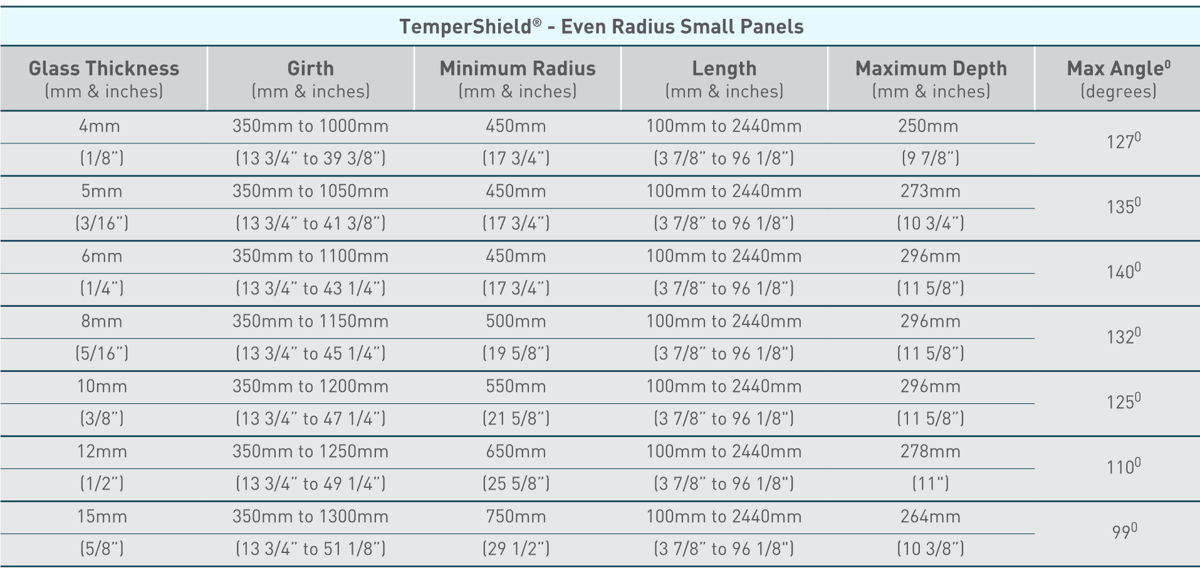
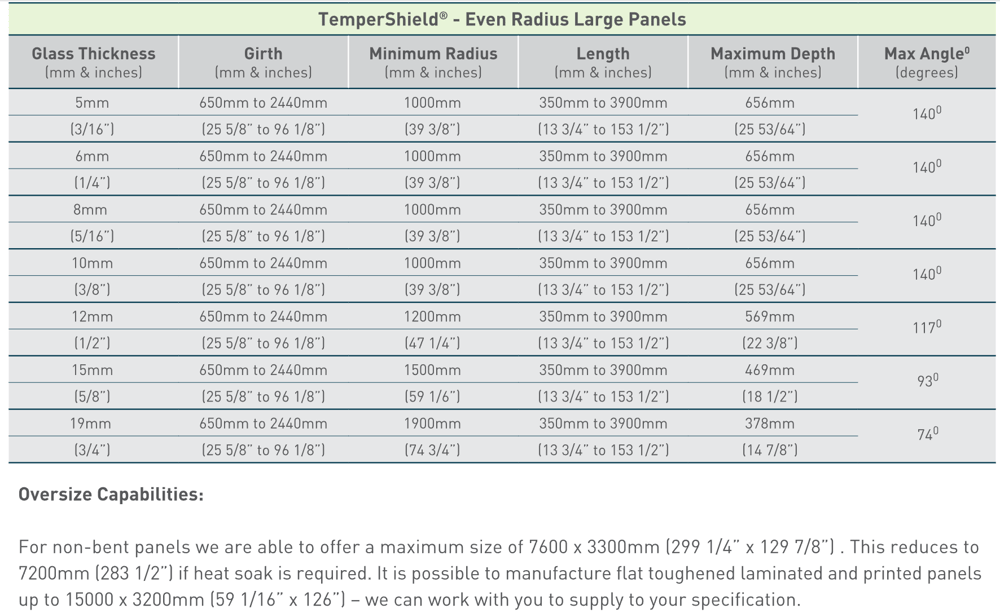
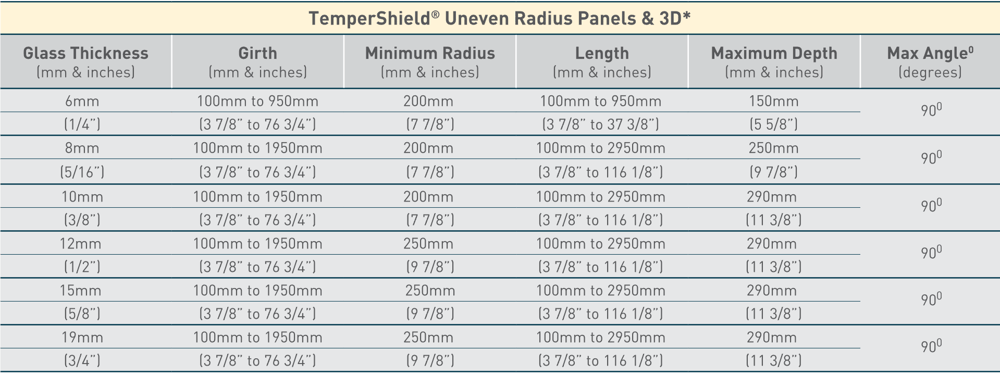
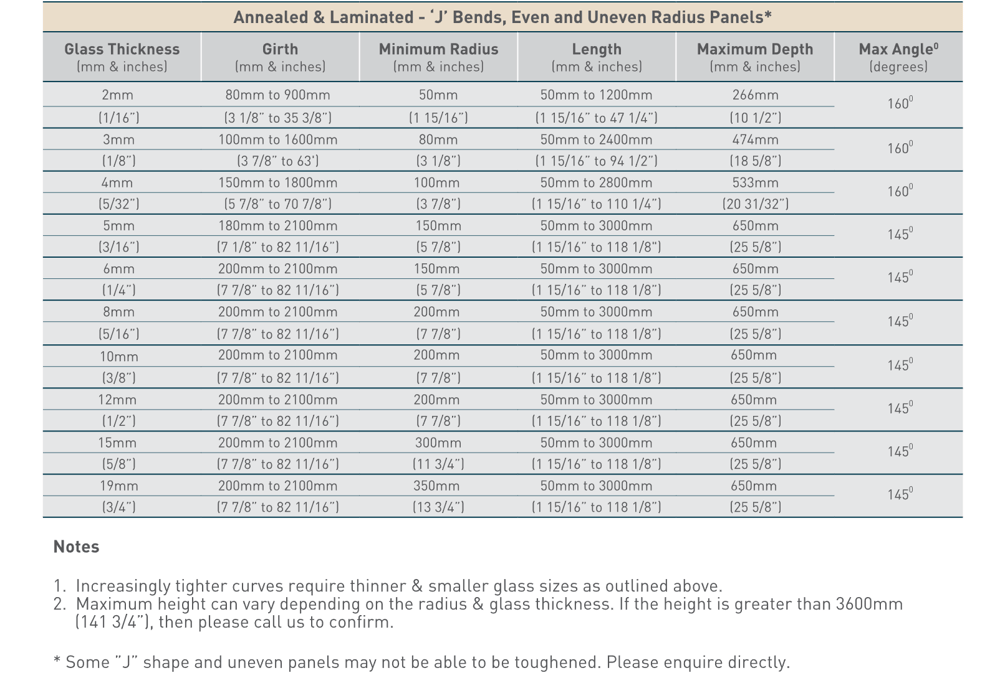
So many variables impact how glass can be curved and bent – please contact us directly to discuss your needs as even complex curves may be achieved. The Bent Glass Specifications & Tolerances guide provides some direction on tolerances for tight curves – generally speaking, increasingly tighter curves require increasingly thinner and smaller panes of glass.
A tolerance of ± half of the thickness of the glass to a maximum of ± 6mm is the accepted industry standard.
Glasshape® bends glass by either heating and rolling the glass while in a plastic state, or by the process of “sag bending”. Glass is a visco-elastic material whose mechanical properties change rapidly when heated between 600º and 700º C becoming a ‘plastic’ substance. The science of glass bending uses this plastic phase to produce shapes which are both complex yet free from wrinkles and other optical aberrations starting from flat float glass.
Optical distortion sets the limit for most shaping. All bending requires precise control of stress levels to ensure the product meets regulatory, environmental, robustness and optical requirements. A degree of distortion, both when looking through and in reflection, is inevitable in bent glass, particularly when viewing a moving object through the glass.
All bent glass should be site inspected from a minimum distance of 3m and viewed at right angles to the glass. It should also be noted that bent glass will split direct sunlight into striped shadow. Some variation in edgework may be discernible on exposed edges where different machine or hand forming is required for manufacturing. Such variation will be kept to a minimum.
Standard glazing techniques for flat glass also apply to bent glass with added consideration of the following:
- Glass radius and rebate radius are rarely exactly the same. Additionally radius at head may differ from that at the sill. Rebate needs to be of sufficient size to accommodate all variances. Where variances occur wet seal is recommended.
- For annealed bent glass and annealed laminated glass wet seal is the preferred method of glazing to avoid breakage from over tight wedge.
- Attention needs to be paid to the frame that the bent glass is being glazed into. In particular attention to the blocking of the frame into the sub-sill in the centre of the bow, as this area may droop over time if not blocked sufficiently.
- Setting blocks and distance pieces: Same as for flat glass with the exception that a central setting block(s) may be required to avoid tipping, depending on the radius.
- Bent glass vacuum lifters are recommended for assisting with moving the glass into position.
Note: flat glass vacuum lifters are not recommended for use on bent glass as they may lose their vacuum suddenly.
Marine Glazing GuideHeavy Macinery Glazing Guide
“Spontaneous glass fracture” refers to incidents where toughened glass windows shatter without warning. These failures are due to the presence of nickel sulphide inclusions. For more information about mitigating this please refer to the Heat Soaked Glass section below.
Glasshape® is able to provide a Heat Soak service that will test panels of toughened (tempered) glass for nickel sulphide inclusions. In almost all cases, this destructive test will cause an affected panel to shatter within the safety of the testing oven. If the panel emerges from the testing oven in-tact we can be almost 100% confident that there are no nickel sulphide inclusions, and the panel will not spontaneously fail as a result.
Special care while storing and handling Glasshape laminated glass products should be taken. Irreparable glass and interlayer (laminate) damage can occur from improper storage and handling, exposure to chemicals and leaching agents, prolonged exposure to moisture, mechanical attack and breakage, damage related to adjacent construction activities and improper cleaning methods.
DELIVERY
Upon delivery of the crated glass, check that the outside of the crate is not damaged or showing signs of impact that may have damaged glass inside. If damage to the crate is discovered, take photos including and Tilt Watch markers that may have been activated.
IMPORTANT: If the crate is a ‘stand up crate’, ensure that it is securely leaning against a firm wall/frame on a 10 degree angle before opening the side. Failure to tilt the crate back against a solid surface may result in injury from glass falling from the crate when the side is removed.
Once the crate has been safely opened, check for any obvious damage by visual inspection before attempting to unload glass. If damage/ breakage is discovered, take photos of the damaged glass before removing from the crate. Edges and corners of glass are particularly vulnerable to damage so these should be checked with special attention. If it was noticed that materials were delivered in damaged condition, then these steps have to be done immediately:
- Inform the driver of the carrier vehicle;
- Take photographs of found damage;
- Make notes about found damage;
- Send a notice to Glasshape within 24 hours to advise of the damage and follow the terms and conditions for warranty claims noted on the Glasshape website.
Check marks and labels on the packing or glass to ensure compliance with the delivery notes and specification. Always use appropriate PPE when unloading crates of glass to ensure safety of all persons involved. Safety gloves, hard hat, safety glasses, suitable footwear with steel cap toes are recommended as a minimum requirement for handing glass.
STORAGE
Temporary or permanent storage may only be in a vertical position in wooden crates, on suitable racks or other appropriate fixtures. If the glass is being stored on static racks, it is recommended that the angle/lean from the vertical would be 3-6⁰. All metal or similar hard parts that will be in direct contact with the glass units have to be lined with rubber or other cushioning material. If several panes are stored together intermediate layers (e.g. intermediate cork or paper pads, stacking layers and similar) are required. Glasshape strongly recommend tempered and laminated glass to be stored inside, in a dry and well-ventilated place. If glass is to be stored outside, it must be protected from exposure to moisture and direct sunlight by means of a suitable full-size cover otherwise production can be permanently damaged. Prolonged exposure to moisture and/or direct sunlight can result in delamination/ moisture ingress in between the glass layers. Proper ventilation of goods, even packing and weight distribution, has to be assured at all times in order to avoid possible glass staining or damage. Temperature for storage of laminated and insulated glass units must be lower than 40°C and higher than 5°C, relative humidity – always below 70%. Crates and racks with glass can be stored only on flat solid ground.
WARRANTY
Glass that suffers damage of any sort as result of improper handling, storage or cleaning is void of any warranty. For more detailed information regarding warranty and recommended cleaning procedures for laminated, tempered and insulated glass units, please refer to: WARRANTIES and CLEANING AND INSPECTION
Delivery, Storage & Handling of Laminated Glass
- Insulating Glass Units must be transported and stored so that both panes of glass are equally supported. Therefore units should be stored vertically or stored on a 90° angle rack set at 4° -7° from the vertical.
- Units may be moved and stored on site storage trolleys.
- Insulating Glass Units should not be stacked more than 6 deep. For various size units, stack the largest against the supports. Where size changes occur, suitable interleaving should be used.
- All Insulating Glass Units must be stored in dry ventilated conditions out of direct sunlight.
- Wrapping plastic over glass for weather protection is not advised as it can allow condensation to accumulate, resulting in damage to the glass or unit seal.
- Insulating Glass Units that are transported or installed at heights exceeding 1200 metres above sea level require special precautions and advice must be sought from the manufacturer.
- Strops or slings which support both panes of glass are recommended for moving Insulating Glass Units.
- If it is necessary to rotate large Insulating Glass Units, a corner block may be used to protect the edge of the unit, or use a vacuum lifter with a rotating head.
- Care must be taken if handling large Insulating Glass Units with suckers, as this can put undue stress on the seals.
- Glass grabs which create a crushing force which can damage the spacer are not recommended.
Color Variations
All glass is essentially made from the “Float Glass” process but the mixture of raw materials can vary slightly. The most noticeable is the iron content and this can make some clear glass more green the others. The iron content can be reduced (low iron glass) to produce a premium, extra clear glass.
The inclusion of metal oxides creates tinted glass in a range of colors (bronze, grey, blue, green), but some manufacturers have slightly different formulations and tint colors. In general the bronze and grey colors are similar but the others can vary and may be challenging to match. In addition the tint varies with the thickness and this adds further complications to color matching. For uniform tinted glass, design for one thickness and source from one supplier.
Clear laminated glass is very similar to clear monolithic float glass of the same thickness, and in most cases no colour variation is noticeable. However, it can happen in some lighting conditions. Tinted PVB laminated glass does not match tinted float glass as it’s the PVB interlayer that is tinted and not normally the glass. In addition there are several suppliers of tinted interlayer and their colours and appearance in certain lighting conditions can vary. The laminate can be made with tinted glass to match if required, and some are offered in this format as standard.
The toughening (tempering) process does not alter the clear or tint color but can introduce to toughened (tempered) glass thermal stress patterns that are visible through polarized light, often known as leopard spots.
-
Coated glass colors do change when viewed at different times of the day, depending on the weather, surrounding reflections, building orientation and the angle at which the glass is viewed. In addition the appearance of reflective glass is distinctly different if the coating is glazed outside on surface 1 or inside on surface 2. The appearance of clear Self Cleaning and Low E coated glass is also slightly different to clear float but this is not normally significant. Some Low E glass can exhibit a blue haze, especially noticeable if part of the glass is shaded.
An IGU will not normally look different from monolithic glass if using the same outer glass. However, the introduction of a Low E coating can slightly increase reflectivity and the internal pressure changes in the unit can create flexing in the glass that changes reflected images. In addition some rare visual effects are possible, such as;
- Brewster’s Fringes, which is a light refraction phenomenon seen as a rainbow effect
- Newton’s Rings, which is a circular rainbow effect evident when the panes are touching in the center
For more information refer data sheet on IGU Design Limitations.
Optical Aberrations
Newton’s rings are named after Sir Isaac Newton who first studied the phenomena. These are interference patterns caused by the reflection of light between two surfaces, a spherical surface and an adjacent nearly flat surface. They appear as concentric rings of rainbow colors and occur only near the center of a unit.
In a large IGU the two glasses may be displaced to touch or nearly touch in the middle by an increase in atmospheric air pressure due to; insufficient pressure equalization during manufacture, heat treated glass bow, incorrect airspace for the unit size, or inadequate glass thickness. This effect is normally a manufacture or specification fault and replacement is required.
Brewster’s Fringes are reflected light phenomena which occur if wavelengths of light meet up at 180 degrees out of phase. This can occur when high quality float glass is used with surfaces which are optically flat and both panes of glass are parallel in the IGU. Light reflected within one glass can combine with that similarly reflected within the other, with such small path differences as to cause interference.
The effect is of faint colored bands or irregular shapes, which can be located anywhere over the surface. It is rarely noticeable in normal lighting conditions.
Brewster’s Fringes are not a manufacturing fault but can be generally avoided by using IGUs of unequal glass thickness.
IGU’s containing heat treated glass may exhibit a similar level of distortion as heat treated monolithic glazing. This is normally visible on an oblique angle perpendicular to the direction of the toughening furnace rollers, and more obvious in reflection than in transmission.
Where IGU’s contain two or more panes of toughened glass this effect may be increased. For this reason, units containing multiple panes of toughened glass particularly where reflective or coated glass is involved should be evaluated for possible visual issues associated with roller wave distortion.
Where thermal stress prevents the use of annealed glass in both panes, the use of heat strengthened glass instead of toughened glass (tempered glass) may be considered as often the roller wave is reduced. Roller wave is not a manufacturing fault but an industry recognized and accepted inherent feature of heat treated glass.
As a standard IGU has four reflective surfaces, a higher level of reflectivity occurs and multiple images in reflection may be created. This will be more apparent when viewed on an angle to the glass and is an inherent property of the unit.
Due to the sealed airspace of an IGU differences in temperature and atmospheric pressure from the time of manufacture will cause the IGU to act as a lens. This can cause significant changes in the images reflected from the windows due to glass deflection. The appearance is of a convex distortion when the glass is bowing outwards and a concave distortion when bowing inwards. The effect will be more noticeable when reflective coatings are incorporated within the IGU, and in larger units.
Haze is the scattering of light rays when visible light passes through a transparent material. The amount of haze in ordinary glass is very low and is not detected by the human eye.
High performing IGU’s often incorporate Low E coated glass. With any coated glass it is possible to see the presence of the coating under certain lighting conditions. When bright sunlight shines directly onto partly shaded, coated glass and there is deep shade on both sides of the glass, haze may be visible and usually has the appearance of a blue-grey film or dust on the glass. The shaded area will be free of the effect, giving a clean appearance in the shadow.
The effect will be more noticeable on some types of coated glass than on others. Vacuum or sputter coated Low E glass products generally have a very low amount of haze, Pyrolytic coatings tend to have higher levels of haze that can be more readily seen by the human eye. Haze is not a manufacturing flaw, rather an industry known and recognized inherent feature of IGU’s.
Manufacturing Bent Glass Parameters:
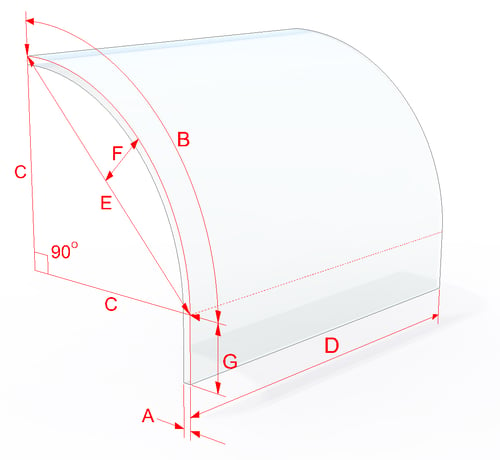
- A: Glass Thickness
- B: Outside Girth
- C: Bend Radius
- D: Panel Length / Height
- E: Outside Cord
- F: Drop
- G: Tangent